
TL;DR:
- Bathroom remodels typically recover 65% to 80% of their cost at resale, making them a reliable investment for flippers. Focusing on cost-effective, neutral updates improves resale value, speeds up sales, and reduces negotiation risks. Avoid over-spending on luxury features to protect profit margins in mid-market properties.
Bathroom remodel ROI is defined as the percentage of your renovation investment you recover at resale, and for flippers, it directly determines whether a project turns a profit or bleeds cash. A mid-range bathroom remodel recoups between 65% and 80% of its cost at resale, making it one of the most reliable interior upgrades available to investors. Understanding why bathroom remodel ROI matters for flippers goes beyond a single number. It shapes resale price, time on market, and your exposure to costly buyer renegotiations. In 2026, with flipping margins under real pressure, getting this calculation right is the difference between a clean exit and a deal that drags. Myreadyrenovation works with investors who need professional results without overcapitalizing.
Why bathroom remodel ROI matters for flippers
Bathroom remodel ROI is the industry term for the ratio of resale value gained to renovation dollars spent. For flippers, it functions as a risk management metric, not just a value-add calculation. Flipping profit margins have compressed to approximately 25.4%–25.5% in early 2026, the lowest since 2008. That compression means every dollar spent on a bathroom must work harder than it did three years ago.
Bathrooms also outperform kitchens on a percentage-return basis for flippers with limited capital. That makes them the smarter first target when you are prioritizing where to spend. A kitchen remodel costs more, takes longer, and carries higher risk of overcapitalization in mid-market properties. A well-executed bathroom upgrade delivers a cleaner, faster return.
The practical implication is straightforward. Flippers who treat bathroom remodeling as a sizing and risk management challenge, rather than a luxury upgrade opportunity, consistently outperform those who chase high-end finishes in mid-market homes.
What factors determine the ROI of a bathroom remodel for flippers?
Several cost drivers and market conditions shape how much return you actually see from a bathroom renovation investment.
Cost structure matters first. Labor accounts for 40%–65% of total bathroom remodel costs, with full project costs ranging from $8,000 to $40,000 depending on scope and finish level. That labor percentage is the primary reason DIY tempts flippers. But unlicensed or unpermitted work creates appraisal and inspection problems that cost more to fix than they saved.
Market alignment is the second driver. Spending above neighborhood expectations causes diminishing returns. A $25,000 spa bathroom in a $180,000 neighborhood does not add $25,000 to your sale price. Buyers in that price range have a ceiling, and luxury features above it go uncompensated.
Key factors that shape bathroom remodel ROI for flippers:
- Neighborhood price ceiling: Comps define the maximum resale value. Your remodel budget must stay well below that ceiling to preserve margin.
- Scope of work: Cosmetic refreshes (paint, fixtures, lighting) deliver faster ROI than full gut renovations.
- Permit and inspection compliance: Licensed contractors and proper permits improve appraisal confidence and buyer trust, directly supporting your asking price.
- Finish level: Mid-grade finishes in neutral tones outperform both budget materials and high-end custom work in resale performance.
- Labor quality: Professional installation with warranties reduces callback risk and prevents inspection red flags.
Pro Tip: Pull comps within a half-mile radius before setting your bathroom remodel budget. If the top three comparable sales show $220,000 as the ceiling, your total renovation spend across the property should leave room for profit at that number, not push past it.
How does bathroom remodel ROI impact resale price and time on market?
Bathroom upgrades affect your flip in two distinct ways: direct price support and indirect speed benefits. Most flippers track the first and underestimate the second.
Direct price support
A renovated bathroom signals move-in readiness to buyers. That signal supports your asking price and reduces the gap between list and offer. Buyers who see a clean, functional bathroom with updated fixtures make fewer low-ball offers because they cannot point to obvious repair needs.
Indirect benefits: speed and negotiation risk
The indirect ROI of bathroom remodels is often where the real money hides. Tub-to-shower conversions improve perceived value at a relatively low cost and reduce buyer objections during walkthroughs. Fixing leaks, replacing ventilation fans, and updating lighting all reduce the list of items a buyer’s inspector will flag.
Consider the carrying cost math:
- A flip sitting on the market for 90 days instead of 45 days costs you an additional month and a half of mortgage payments, taxes, insurance, and utilities.
- A buyer who discovers a leaking toilet or moldy subfloor during inspection has grounds to renegotiate. That renegotiation typically costs more than the repair would have.
- A bathroom that passes inspection cleanly accelerates closing and reduces the chance of a deal falling apart entirely.
- Faster sales also free up capital for your next acquisition, compounding your annual return across more projects.
The greatest indirect ROI gain comes from improvements that reduce time on market and buyer negotiation risk. Fixing leaks and updating ventilation are not glamorous, but they protect your margin more reliably than a designer vanity does.
Pro Tip: Budget a specific line item for “inspection-proofing” your bathroom before listing. Target plumbing, ventilation, and water damage first. These repairs cost far less upfront than they do as post-inspection concessions.
What remodeling strategies maximize bathroom ROI without over-investing?
The goal is not the most impressive bathroom on the block. The goal is the most appropriate bathroom for the price point. Those are very different targets.
Neutral, durable finishes outperform trendy or high-end custom work in resale performance. Classic vanities, matte fixtures, and subway tile appeal to the widest buyer pool and avoid the “project” signal that budget materials send. Buyers in most mid-market price ranges want clean and functional, not custom and bold.
Practical strategies that consistently deliver strong bathroom renovation investment returns:
- Fix defects before adding features. A cracked tile floor with a new vanity still fails inspection. Structural and functional repairs come first.
- Update lighting. Replacing a single overhead fixture with a vanity bar light costs under $200 installed and visually modernizes the entire room.
- Replace ventilation. A working exhaust fan prevents moisture damage and satisfies inspectors. It costs $150–$300 installed and eliminates a common inspection flag.
- Resurface or replace the tub. A tub-to-shower conversion appeals to buyers who prefer showers and removes a fixture that often shows age badly.
- Choose classic over current. Shaker-style vanities, chrome or brushed nickel hardware, and white or gray tile age well and photograph well.
- Avoid luxury upgrades in mid-market flips. Heated floors, custom tile work, and frameless glass enclosures cost significantly more than they return in most markets.
The bathroom staging renovation guide from Myreadyrenovation covers how to align finish choices with local buyer expectations, which is the core skill for maximizing ROI without overspending.
Pro Tip: Walk three open houses in your target neighborhood before finalizing your bathroom plan. Note what buyers comment on positively and what they flag as problems. That field research is worth more than any national trend report.
How to measure and estimate bathroom remodel ROI for your flip?
Estimating ROI before you spend is the discipline that separates profitable flippers from break-even ones. The framework is straightforward.
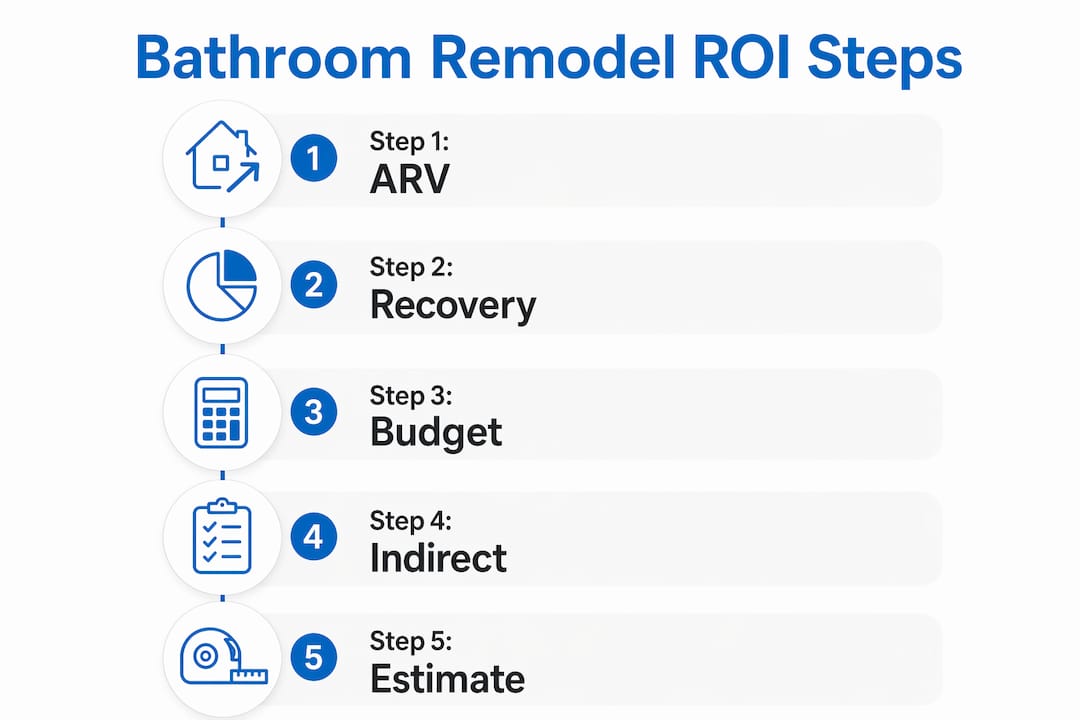
Step 1: Establish your after-repair value (ARV). Pull recent comps for comparable properties with updated bathrooms in your target neighborhood. The difference between comps with renovated bathrooms and those without gives you the realistic value ceiling your remodel can support.
Step 2: Apply the 65%–80% recovery range. If comps show that an updated bathroom adds $12,000 to resale value, a remodel costing $10,000–$15,000 falls within the range where you recover most of your spend. Spending $25,000 to gain $12,000 destroys margin.
Step 3: Set your spend relative to ARV. A general rule for flippers is to keep bathroom remodel spend at roughly 20%–33% of the value increase you expect, not 20%–33% of ARV itself. This keeps the math honest.
| Scenario | Remodel Cost | Expected Value Gain | Estimated ROI |
|---|---|---|---|
| Cosmetic refresh | $5,000 | $8,000–$10,000 | 160%–200% |
| Mid-range remodel | $12,000 | $10,000–$14,000 | 65%–80% |
| Full gut renovation | $30,000 | $18,000–$24,000 | 60%–80% |
The cosmetic refresh scenario consistently outperforms full gut renovations on ROI percentage. That result surprises many flippers who assume bigger spend means bigger return.
Step 4: Account for indirect ROI. Add the carrying cost savings from a faster sale to your ROI calculation. If a clean bathroom closes your deal 30 days faster, that is one fewer month of holding costs. In most markets, that is $1,500–$3,000 in real savings that never shows up in the resale price comparison but absolutely shows up in your net profit.
Myreadyrenovation offers professional bathroom remodeling services designed to help flippers hit the mid-range sweet spot without guessing at costs or scope.
Pro Tip: Build your ROI estimate in two columns: direct (resale price increase) and indirect (holding cost savings, reduced concessions). Flippers who only track direct ROI consistently undervalue the bathroom upgrade decision.
Key takeaways
A bathroom remodel delivers 65%–80% ROI at resale and reduces time on market, making it the highest-priority upgrade for flippers working within compressed 2026 margins.
| Point | Details |
|---|---|
| ROI range for mid-range remodels | Mid-range bathroom remodels recover 65%–80% of cost at resale, making them reliable investments. |
| Market alignment prevents overcapitalization | Spending above neighborhood price ceilings adds cost without adding resale value. |
| Indirect ROI is real money | Faster sales and fewer inspection concessions add measurable profit beyond the resale price increase. |
| Cosmetic refreshes outperform gut renovations | A $5,000 cosmetic update often delivers higher ROI percentage than a $30,000 full renovation. |
| Licensed work protects your return | Permitted, professional installation supports appraisals and reduces buyer negotiation risk. |
What I’ve learned about bathroom ROI after watching flippers get it wrong
The most common mistake I see is flippers treating the bathroom as a showcase instead of a transaction tool. They install frameless glass, designer tile, and vessel sinks in a $175,000 neighborhood and then wonder why their $210,000 ask sits on the market for 60 days.
Bathroom remodel ROI is fundamentally a risk management exercise. The bathroom’s job in a flip is to pass inspection, signal cleanliness, and remove buyer objections. It is not to impress. The moment you start spending to impress buyers in a mid-market flip, you are spending money that will not come back.
The flippers I have seen consistently profit are the ones who walk the neighborhood first, set a hard budget ceiling, and then execute cleanly within it. They fix the leak. They replace the fan. They put in a classic vanity and neutral tile. They do not agonize over grout color. They close on time and move to the next deal.
The 2026 market makes this discipline non-negotiable. With gross margins at their lowest point in nearly two decades, there is no room for vanity projects. Every dollar spent on a bathroom has to have a clear path back to your pocket, either through a higher sale price or a faster close. If you cannot trace that path before you spend, do not spend it.
The benefits of in-floor radiant heating are real in the right market and price point, but they are a feature for a $400,000 home, not a $200,000 flip. Know your market, know your ceiling, and let that knowledge drive every decision.
— Eric
How Myreadyrenovation helps flippers get bathroom ROI right
Flippers working in the Fraser, MI area have a specific advantage: access to a remodeling team that understands local buyer expectations and price ceilings.
Myreadyrenovation specializes in bathroom remodeling services built for budget-conscious investors who need professional results without overcapitalizing. The team works with licensed contractors, pulls proper permits, and delivers finishes that support appraisals and pass inspections cleanly. Every project is scoped to match the neighborhood, not to exceed it. If you are planning a flip and want a bathroom remodel estimate aligned to your ARV and local comps, Myreadyrenovation offers free consultations to help you set the right scope from the start.
FAQ
What is a good ROI for a bathroom remodel on a flip?
A mid-range bathroom remodel typically returns 65%–80% of its cost at resale. Cosmetic refreshes often exceed that range, making them the strongest ROI option for budget-conscious flippers.
How much should a flipper spend on a bathroom remodel?
Bathroom remodel costs range from $8,000 to $40,000 depending on scope. Flippers should target the lower end of that range with cosmetic and functional upgrades unless comps clearly support a higher spend.
Does a bathroom remodel help sell a house faster?
A renovated bathroom reduces inspection flags and buyer objections, which shortens time on market. Faster sales lower holding costs and increase net profit on the flip.
What bathroom upgrades give the best ROI for flippers?
Lighting updates, ventilation replacement, tub-to-shower conversions, and neutral vanity replacements consistently deliver the strongest returns. These upgrades cost less and appeal to the widest buyer pool.
Does over-improving a bathroom hurt a flip’s profitability?
Spending above neighborhood price ceilings adds cost without adding resale value. Luxury features in mid-market homes return less than their cost, compressing margins on an already tight flip.